
Court Reporting Curriculum and Grading
A 108-Week Path to a Court Reporting Diploma
Our diploma program runs 108 weeks, or 432 hours of class time, and is built around nine core courses. Evening classes meet Monday through Thursday from 6:00 to 9:00 pm at our Buffalo campus, and students add two to three hours of daily practice at home. The program blends stenotype theory and speedbuilding with the academic knowledge a working reporter uses every day.
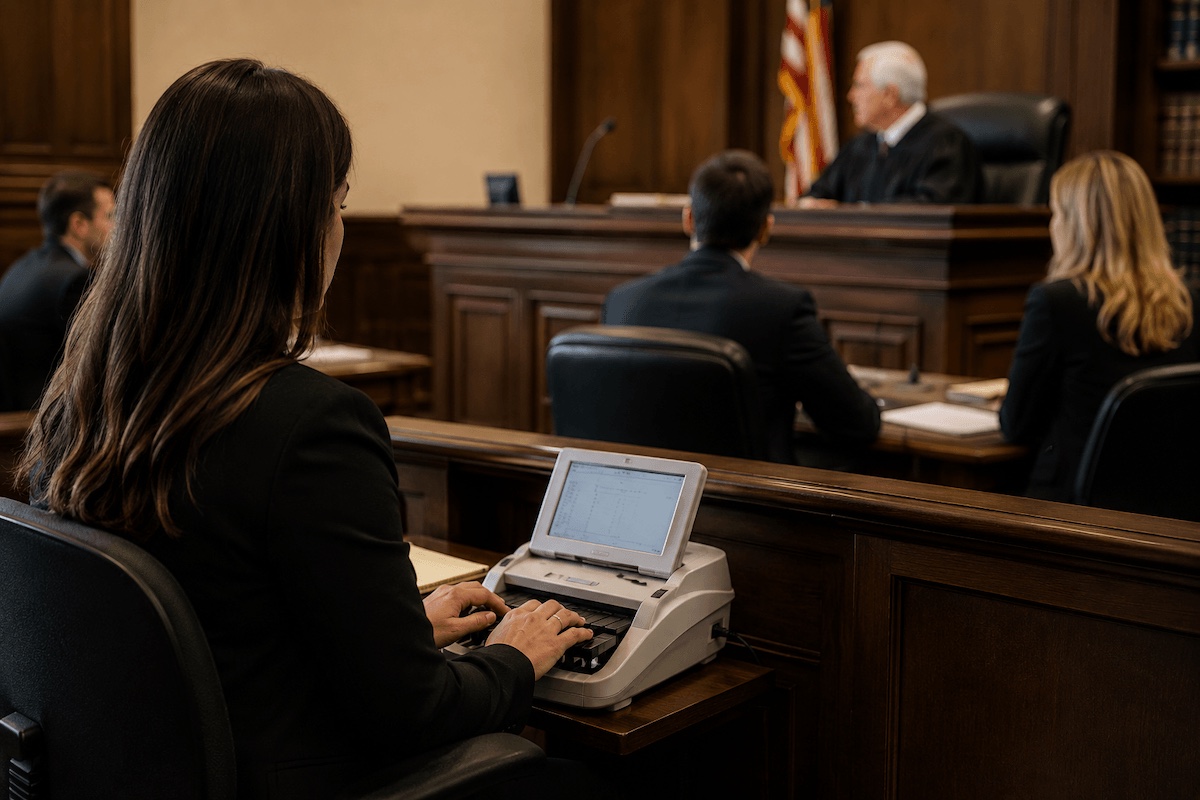
The Core Courses
- Machine Shorthand Theory: the methodology, reasoning, and techniques of shorthand on a stenotype, so you can both read and write machine shorthand.
- Machine Shorthand Speed Building: daily practice on the stenotype machine that carries you to the 225 words-per-minute graduation standard.
- Keyboarding: reach a minimum of 40 adjusted words per minute, rated by adaptive response software, while learning to navigate Windows.
- Computer Aided Transcription (CAT): use a Windows-based application to produce a realtime translation, manage the files tied to that translation, and modify a core dictionary for your personal writing style.
- English for Court Reporters: Standard English and the punctuation of extemporaneous speech, which is common in most hearings.
- Legal Terminology: the vocabulary and language of legal proceedings.
- Medical Terminology: the medical vocabulary that appears in testimony and records.
- Court Procedures: how courtrooms operate and where the reporter fits in.
The Standards You Meet to Graduate
Grading at the Institute is built around clear, measurable benchmarks. Machine speed tests begin at 75 words per minute and advance toward the graduation level of 225 words per minute. Every speed test is passed at a minimum accuracy of 95 percent.
| Requirement | Standard to Pass |
|---|---|
| Machine speed tests | 75 wpm up to 225 wpm, at 95% accuracy |
| Keyboarding | Minimum 40 adjusted words per minute |
| Written tests (theory, English, legal and medical terminology) | Minimum grade of 70% |
If progress is unsatisfactory, as determined by the director, the student is given a probationary period of two months in which to improve. If a student does not improve during the probationary period, the student is dismissed. These standards keep every graduate ready for the speed and accuracy the profession demands.
Frequently Asked Questions
The diploma program runs 108 weeks, which is 432 hours of class time. Evening classes meet Monday through Thursday from 6:00 to 9:00 pm.
Speed tests begin at 75 words per minute and build to the graduation level of 225 words per minute, each passed at a minimum accuracy of 95 percent.
Written tests of theory, English, and legal and medical terminology require a minimum passing grade of 70 percent. Keyboarding requires a minimum of 40 adjusted words per minute.
If the director determines that progress is unsatisfactory, the student is given a two-month probationary period to improve. A student who does not improve during probation is dismissed.